
The Tool Deduction That Kept Going: Davis-Bacon Deductions

Under the Davis-Bacon and Related Acts, a company cannot profit from employee payroll deductions. That rule sounds straightforward. This contractor found a creative way to test it.
The Story
An employee needed personal tools. They put the purchase on a company card, a normal and practical arrangement that happens on job sites every day.
The company began deducting the cost of the tools from the employee's paycheck. Also familiar. Everyone involved understood it as a loan being paid back.
Then the tools were paid off.
But the deductions kept coming.
Wait a minute.
Then it got worse. The company had been quietly charging a 50% "administrative fee" on all company card purchases, and collecting that fee through payroll deductions.
The tools cost what they cost. The "administrative fee" was pure profit, extracted from the employee's paycheck one deduction at a time and placed straight into the coffers of the employer.
Where It Went Wrong, and It Started Earlier Than You'd Think
Most people reading this spot the violation at the 50% fee. That one is obvious. But the arrangement was already outside the rules on day one, and that's the part worth slowing down for.
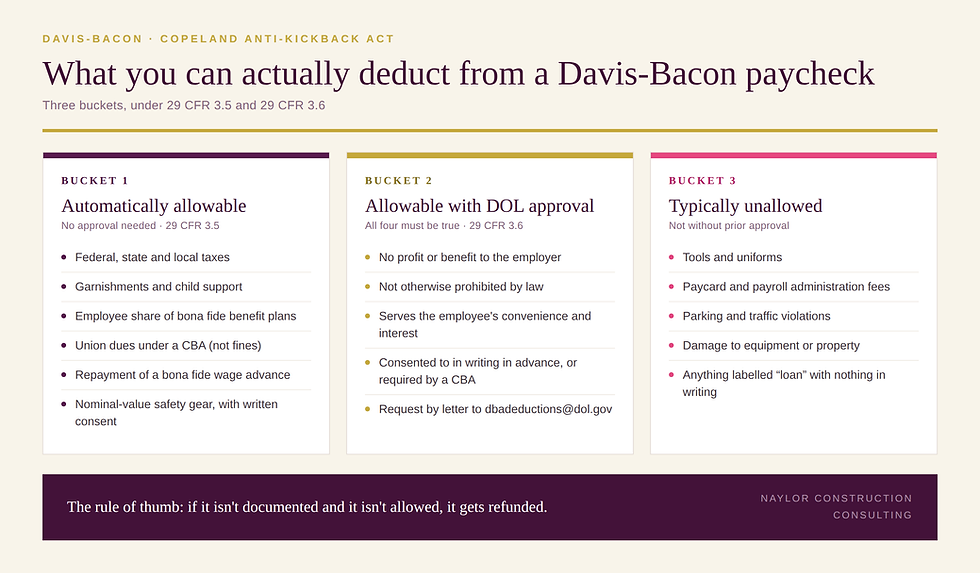
Davis-Bacon has a specific list of deductions allowed automatically: taxes, court-ordered deductions, benefit plan contributions, union dues, credit union payments, charitable contributions, reasonable room and board, nominal-value safety equipment, and the repayment of a bona fide prepayment of wages.
That last one is where people get tripped up. A bona fide prepayment means cash advanced to the worker, without discount or interest, with complete freedom to spend it however they choose. The company handing over money is covered. The company buying an item and charging it back is a different transaction, and it isn't on the list. Tools, specifically, aren't on the list at all. DOL's position is that a tool deduction needs advance approval from the Wage and Hour Division even when the employer buys at a discount for the worker's genuine personal use.
Which means this arrangement needed authorization before the first dollar came out.
And authorization requires all four of these to be true:
The company cannot profit or benefit, directly or indirectly, from the deduction.
The deduction is not otherwise prohibited by law.
It serves the convenience and interest of the worker.
The worker voluntarily consented in writing, in advance, or the deduction is provided for in a collective bargaining agreement.
A 50% administrative fee fails the first test before you even reach the others. It serves exactly one party's interest, and it is not the worker's. And continuing to deduct after the debt was repaid is just wage theft dressed up as accounting.
There is a compliant version of this scenario: advance the employee cash, without discount or interest, let them buy their own tools, and recover it on a repayment schedule they signed. Same outcome for the worker. Fully allowable. The company just picked the wrong mechanism and then made it worse by adding their fee.
Why This Comes Up More Than You'd Think
Tool and equipment deductions are common on construction projects. So are arrangements where company cards cover expenses that benefit the employee. The mechanics are familiar enough that it's easy to let the details slide, or to get creative with the fee structure and assume nobody will look closely.
The DOL looks closely. Certified payrolls document wages paid, hours worked, and deductions taken. When deductions don't reconcile, or when the math reveals a 50% markup on every card transaction, that's the kind of thing that surfaces in an audit and then requires a lot of explaining.
The deductions in this case didn't just violate Davis-Bacon. They reduced wages below the required prevailing wage rate, which triggered back wage liability on top of the deduction violations.
The Lesson
Payroll deductions on prevailing wage projects are not a gray area. The rules are specific: allowed deductions have a defined list, anything outside it requires DOL permission in advance, and no deduction can be a profit center for the company.
The test isn't whether the arrangement feels fair or whether the employee agreed to it. It's whether the deduction appears on the list, and if it doesn't, whether you got approval before payroll ran.
If your payroll setup includes a deduction that isn't on the Davis-Bacon allowed list, get it reviewed before the next run.
For the full breakdown of what's allowed, what needs approval, and what documentation to keep on file, see our guide to What You Can Actually Deduct From a Davis-Bacon Paycheck.
Frequently Asked Questions
What payroll deductions are allowed on prevailing wage projects without DOL permission?
Davis-Bacon and its Related Acts (DBRA) automatically permit deductions for taxes and other legally required withholding, repayment of a bona fide prepayment of wages, court-ordered deductions such as garnishments and child support, the worker's contributions to bona fide benefit plans, regular union initiation fees and membership dues (not fines or special assessments), credit union payments, voluntary charitable contributions, the reasonable cost of board and lodging, and safety equipment of nominal value the worker buys as their own property. Anything outside this list requires advance authorization from the DOL's Wage and Hour Division.
Can a company charge an administrative fee for payroll deductions on a prevailing wage project?
No. Any deduction that results in the company profiting, directly or indirectly, fails the test for allowable deductions under Davis-Bacon. An administrative fee extracted through payroll is a direct profit to the company and is not permissible, regardless of whether the worker consented.
Can we deduct for tools the employee gets to keep?
Not automatically. Tools don't appear on the allowed list, and DOL treats employer-purchased tools as benefiting the employer when the tools are used to perform the work. Even where an employer buys at a discount for a worker's genuine personal use, the deduction requires approval from the Wage and Hour Division first. A cash advance the worker spends themselves is the cleaner path.
What happens if payroll deductions bring an employee's wages below the prevailing wage rate?
The employer owes the difference as back wages. Deductions, even otherwise-legitimate ones, cannot reduce a worker's effective pay below the applicable prevailing wage rate. If they do, the full amount below the required rate is treated as unpaid wages.
This story is real. The 50% fee was real. The worker didn't even notice, but we did.
NCC reviews deduction structures and their supporting documentation as part of every compliance program we run.
This article is general information about federal prevailing wage compliance, not legal advice. Deduction questions can turn on specific facts and state law. For yours, loop in your compliance team or attorney.


Comments