
When "More Compliance" Means More Risk

Updated: Aug 4
A mega-project case study in knowing what the law actually requires
This is the story of how Naylor Construction Consulting (NCC) saved a client north of $11 million a year on a single project just by making sure the compliance program was built for that project, not for someone else's comfort.
Picture a high-value mega-project with a peak workforce of thousands. Now add a third-party compliance consultant, hired by the owner, demanding far more documentation than the Davis-Bacon and Related Acts (DBRA) require and treating that demand as non-negotiable.
On paper, that looks like diligence. In practice, it's a different problem wearing a compliance costume: a program built to generate billable hours for the third-party compliance consultant, not to meet the law's requirements. Most general contractors (GCs) and subs don't know Davis-Bacon well enough to tell what the law actually requires from what a consultant has decided to require — and in many cases, that ends up costing them real money.
The math nobody had run
Nobody had put a number on the compliance consultant's program, so we did. At this workforce scale, the third-party review work alone was projected to cost the GC roughly $120,000 a week — every week, for as long as the project ran — to meet a compliance program that wasn't sized to this project's actual risk.
That's not a normal budget line item. It's not what a GC bids for when they bid on prevailing wage compliance.
That's where NCC's experience comes in: years spent working inside these regulations, a dedicated team, and internal processes built specifically to catch a compliance program that has drifted past the actual risk it's supposed to manage and pull it back in line without giving up an inch of real oversight. The program we created in this case put $108,000 a week back in the GC's pocket. Annualized, that's more than $5.6 million the GC was paying out, and that's before you count what it was costing the subs. Once you account for their side of the ledger — the hours their own back offices were pouring into the same program — the combined weekly savings across the whole project came to more than $200,000. All told, that's over $11 million a year, on one project alone.
Why "more documents" doesn't mean "less risk"
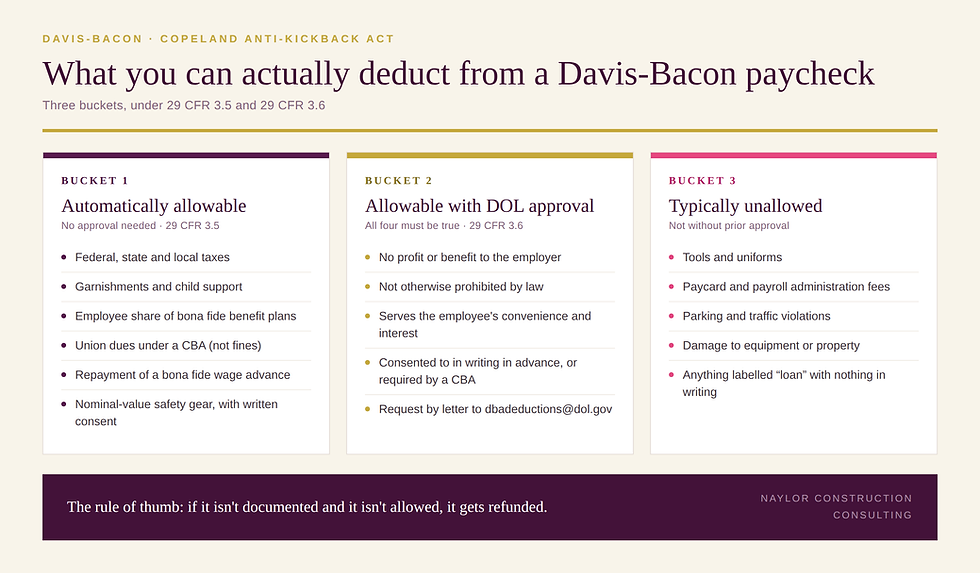
The instinct behind a 100% collection mandate makes sense on its face: if you're not sure what you're looking for, look at everything. But that's not how prevailing wage law works, and it's not how fraud detection works either. Bury a reviewer in 10,000 authorization forms for $2 dental plan deductions, and they're less likely to catch what actually matters: a misclassification, a predatory payroll loan, a genuine wage violation hiding in the noise. Universal collection isn't rigor — it's a haystack, and somewhere in it is a needle nobody has time to find anymore.
There's a fairness problem worth naming here, too. A blanket, high-friction documentation burden lands hardest on the subcontractors least equipped to absorb it, which usually means the smaller, disadvantaged, and minority-owned firms without a dedicated back-office team. "Treat everyone the same" isn't neutral when only the smaller firms feel the weight of it.
What it almost cost
Here's the part that doesn't show up in a spreadsheet: before this got fixed, at least one subcontractor had already made the call to walk. The reason wasn't a wage dispute. It was that the administrative load of the 100% collection mandate wasn't sustainable for their back office, which made leaving the rational business decision.
Fortunately for the GC, our team caught this before it went further, so we never had to run the math on what replacing a subcontractor mid-mega-project actually costs: the re-procurement, the requalification, the schedule delays, the disputes that follow. Anyone who's managed a project at this scale knows that number isn't small. It's the kind of cost that makes a $200,000-a-week admin bill look like a rounding error by comparison, and it's exactly the kind of risk a compliance program is supposed to prevent, not cause.
The fix wasn't less compliance. It was better-aimed compliance.
Our recommendation wasn't to walk away from oversight. It was to build a program scaled to what the project required — no more, no less. That meant a risk-based audit, built on what Davis-Bacon actually requires, costing a fraction as much, and putting the compliance team on the violations that create real exposure for the GC.
That's the job, as we see it: know exactly what the regulation requires, build a program that fits the scale of your project instead of a generic maximum, and put real dollars back on your side of the ledger. That's the difference between a compliance program that protects your project and one that just generates paperwork.
If you're carrying a compliance program you didn't design and can't fully explain, let's talk.
[Disclaimer: This article is intended for general informational purposes only and does not constitute legal advice. Compliance obligations under the Davis-Bacon and Related Acts depend on the specific facts and circumstances of each project, including the terms of the contract and any additional requirements imposed by the contracting agency or project owner. Contractors should consult qualified legal counsel regarding their obligations.]


Comments